
Listening Better
Live Captioning for Better Communication
Communication begins with listening.
In a live conversation, we exchange much more than words. Tone, expression, gestures and pauses all help us understand one another. Yet missing just a few words can make a speaker’s meaning difficult to follow. We may fill the gaps with assumptions and continue without realising that we have misunderstood.
This can be especially challenging across languages and cultures, or when people express themselves indirectly out of politeness or caution.
At Conflux, we have developed a prototype application to explore a simple question: could live captions help us listen to and understand one another better?
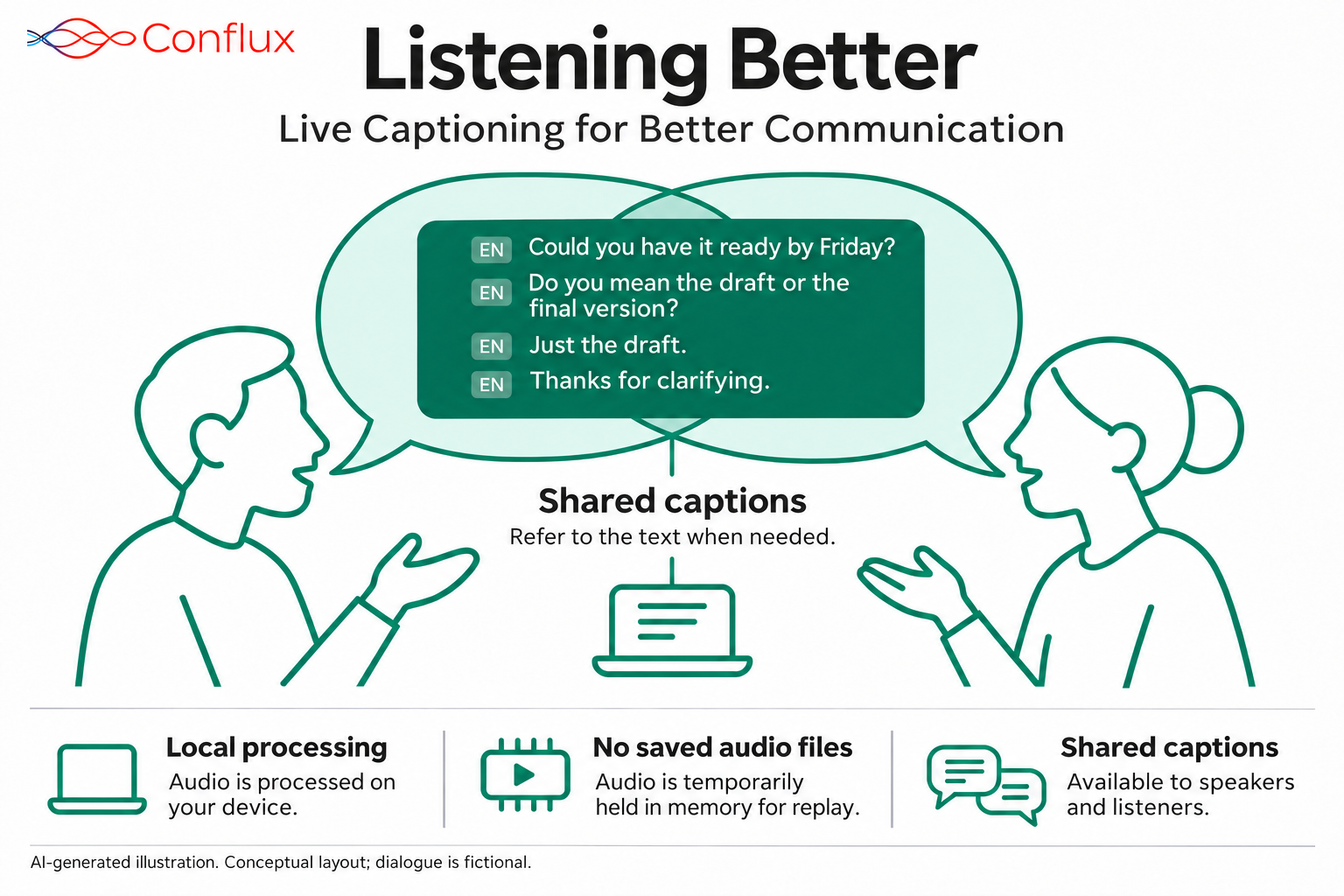
The application converts speech into text on a shared display. Speakers and listeners can refer to it when needed, while keeping their attention on the conversation.
Three design priorities
Local processing Audio is processed on the user’s device, without being sent to an external service.
No saved audio files Audio is temporarily held in memory so that recent speech can be replayed. It is not saved as an audio file.
Shared captions The text is available to both speakers and listeners, offering an opportunity to check words and clarify meaning.
Supporting the conversation
For people speaking a language other than their first, captions may make unfamiliar words easier to follow. Seeing their own speech in text may also give speakers a reason to reflect on how they express themselves.
But captions can be wrong. Looking at a screen can also draw attention away from someone’s face or tone of voice. We want to explore when captions help, when they distract, and how people can use them comfortably.
Conflux is planning workshops where participants can explore how live captions might support listening and understanding.
Our aim is to explore how AI can support people in communicating with one another—with greater attention to what others are trying to say.